
Introduction
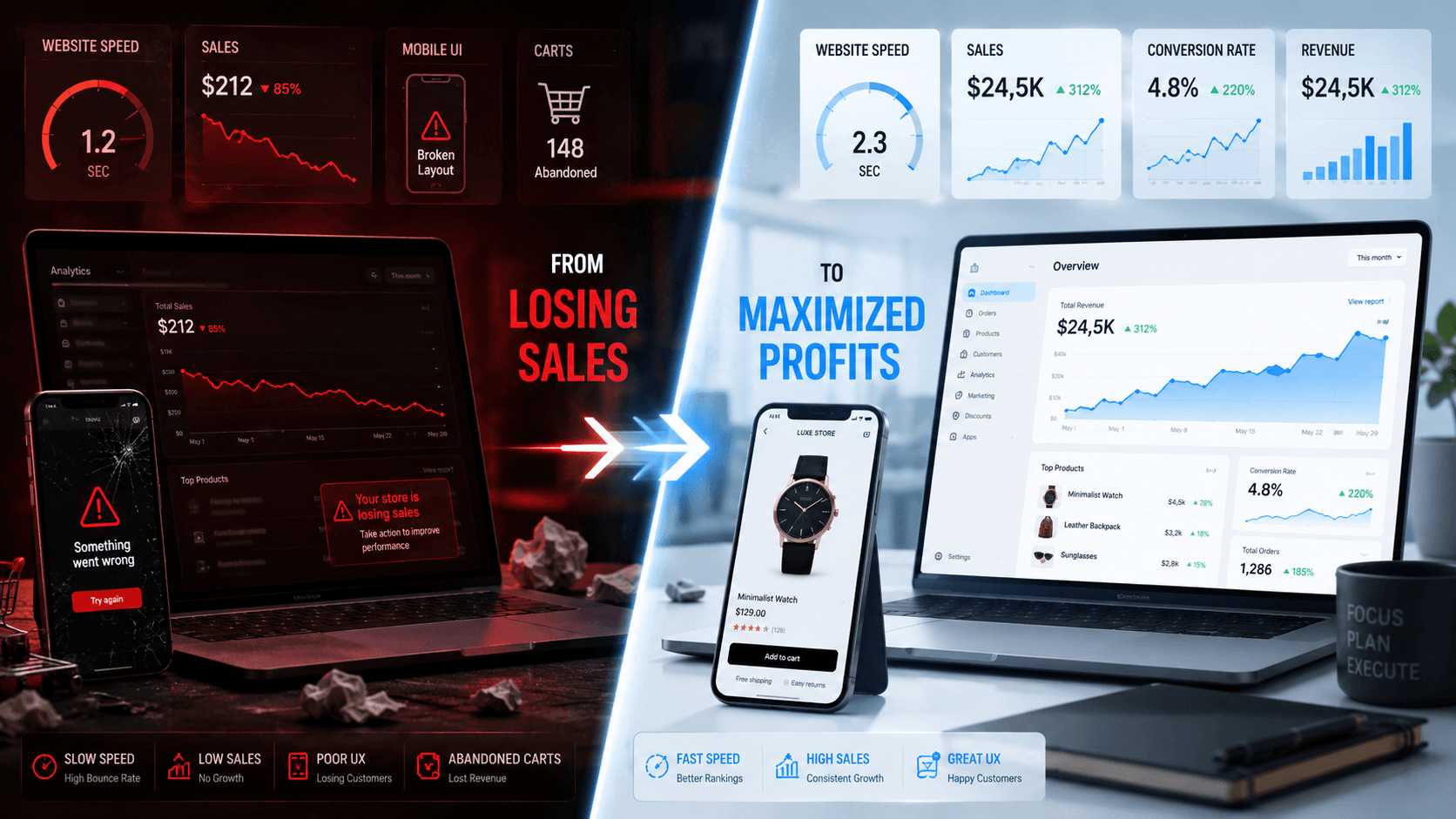
The ecommerce industry is growing faster than ever, but the harsh reality is that most online stores fail within the first few years. Many business owners believe launching a website is enough to generate sales, but modern ecommerce success requires far more than just uploading products online.
From poor website performance and weak branding to slow loading speed and low conversion optimization, many ecommerce businesses struggle because they ignore the technical and strategic foundation required to scale successfully.
Smart brands approach ecommerce differently. They focus on customer experience, mobile optimization, page speed, trust-building, and conversion-driven design. Instead of simply creating a website, they build a scalable digital ecosystem designed for long-term growth.
In this blog, we’ll explore the biggest reasons ecommerce websites fail and how successful brands use smarter strategies to scale faster and dominate the online market.
The Biggest Reasons Ecommerce Websites Fail
1. Poor Website Design Creates Low Trust
Your website is your digital storefront. If it looks outdated, cluttered, or unprofessional, visitors leave within seconds.
Many ecommerce businesses use generic templates without considering:
- User experience
- Mobile responsiveness
- Product presentation
- Navigation structure
- Brand identity
Customers judge trust instantly. A poorly designed store reduces credibility and directly impacts sales.
Smart Brands Do This Instead:
Successful brands invest in:
- Premium UI/UX design
- Clean layouts
- Conversion-focused landing pages
- Professional branding
- High-quality product visuals
Platforms like Shopify, WordPress, WooCommerce, and BigCommerce become powerful when combined with strategic design and optimization.
2. Slow Website Speed Kills Sales
Website speed is one of the most important ranking and conversion factors.
Studies consistently show that users leave websites if pages take more than a few seconds to load. Slow speed affects:
- SEO rankings
- User experience
- Cart conversions
- Bounce rates
- Mobile usability
Common Speed Problems:
- Unoptimized images
- Heavy themes
- Poor hosting
- Too many plugins
- Unoptimized code
- No caching setup
Smart Brands Focus On:
- Core Web Vitals optimization
- Lightweight design systems
- CDN integration
- Image compression
- Mobile-first performance
- Advanced caching
A fast ecommerce website not only improves SEO but also significantly increases revenue.
3. Weak Mobile Experience
More than half of ecommerce traffic now comes from mobile devices, yet many stores are still built primarily for desktop users.
Common mobile issues include:
- Broken layouts
- Tiny buttons
- Slow mobile speed
- Difficult checkout process
- Poor navigation
Smart Brands Prioritize:
- Mobile-first design
- Responsive product pages
- Fast-loading mobile layouts
- Sticky add-to-cart functionality
- Optimized mobile checkout
A smooth mobile experience directly improves conversions and customer retention.
4. No Conversion Optimization Strategy
Traffic alone does not generate sales. Many ecommerce businesses spend money on ads but fail to optimize conversion funnels.
Without conversion optimization, stores lose potential customers every day.
Common Conversion Mistakes:
- Weak product pages
- Poor CTA buttons
- Complicated checkout
- Lack of trust signals
- No urgency elements
- Low-quality product descriptions
Smart Brands Use:
- A/B testing
- High-converting product layouts
- Strategic CTA placement
- Social proof
- Customer reviews
- Upsell and cross-sell systems
Scaling ecommerce requires maximizing every visitor’s value.
5. Bad SEO Structure
Many ecommerce websites fail because they are invisible on search engines.
Poor SEO setup includes:
- Missing meta titles
- Duplicate content
- Weak keyword targeting
- Slow indexing
- Poor URL structure
- Thin product descriptions
Smart Brands Invest In:
- Technical SEO
- Optimized category pages
- SEO-focused blog content
- Internal linking
- Schema markup
- Keyword strategy
Organic traffic becomes one of the most powerful long-term growth channels for ecommerce brands.
How Smart Ecommerce Brands Scale Faster
1. They Build Scalable Platforms
Successful brands choose scalable ecommerce platforms based on business goals.
Popular Scalable Platforms:
- Shopify for fast-growing ecommerce brands
- WooCommerce for flexible WordPress-based stores
- BigCommerce for enterprise-level ecommerce
- WordPress for content-driven business growth
The right platform improves flexibility, integrations, and long-term scalability.
2. They Invest In Branding
Modern ecommerce success is driven by branding, not just products.
Strong brands focus on:
- Visual identity
- Premium user experience
- Consistent messaging
- Trust and authority
- Emotional customer connection
People remember brands that create experiences, not just stores.
3. They Optimize Every Stage Of The Customer Journey
Scaling brands carefully optimize:
- Homepage experience
- Product pages
- Checkout process
- Email marketing
- Retargeting funnels
- Customer support
Every touchpoint affects customer retention and lifetime value.
4. They Use High-Converting Landing Pages
Landing pages are essential for:
- Paid ads
- Product launches
- Lead generation
- Seasonal campaigns
Smart brands use dedicated landing pages instead of sending traffic to generic pages.
High-converting landing pages include:
- Strong headlines
- Clear CTA sections
- Trust indicators
- Fast loading speed
- Conversion-focused layouts
5. They Continuously Improve Performance
Successful ecommerce businesses constantly analyze:
- Heatmaps
- User behavior
- Conversion data
- SEO rankings
- Website speed
- Cart abandonment
Continuous optimization creates sustainable long-term growth.
Why Professional Ecommerce Development Matters
Building a successful ecommerce business requires more than installing a theme.
Professional ecommerce development helps businesses:
- Improve conversions
- Increase SEO performance
- Optimize speed
- Create premium branding
- Scale efficiently
- Improve customer experience
At Orbitwebx, we help businesses build high-performance ecommerce websites designed for growth using:
- Shopify Development
- WordPress Development
- WooCommerce Development
- BigCommerce Solutions
- Landing Page Design
- Page Speed Optimization
- Ecommerce SEO Optimization
Final Thoughts
Most ecommerce websites fail because they focus only on launching instead of optimizing.
Smart brands understand that ecommerce growth depends on:
- User experience
- Speed optimization
- Mobile performance
- SEO strategy
- Conversion optimization
- Professional branding
The ecommerce industry is highly competitive, but businesses that invest in scalable systems and premium customer experiences position themselves for long-term success.
If you want to build a high-converting ecommerce website that scales faster, working with the right ecommerce development partner can make all the difference.